
Understand chord structures, harmony, and progressions used in modern piano music.
learn more
Develop technique, finger control, and musical fluency through essential piano scales.
learn moreThe DNA of the piano
Every
pianist, whether they realize it or not, speaks the same language. A language
built from three simple, yet infinitely powerful building blocks: notes,
chords, and scales. These three are the molecules of music — the structures of
sound from which all music is written. You could
call them The Big 3.
Together,
they form the foundation of every song you’ve ever heard, every piece you’ve
ever admired, every improvisation that gave you goosebumps.
When you
truly understand these three, you unlock the freedom to play. Music stops being
complicated — it becomes familiar, logical, something you can both understand
and create.
Many people
think they need to “learn to read notes” in order to play piano. Not true!
Reading is useful, sure, but reading and playing music without understanding
The Big 3 is like memorizing sentences in a language you don’t actually speak.
You can repeat them, but you won’t pronounce them well and you won’t understand what you’re really saying. When you understand notes, chords, scales, and how they connect, you stop copying and start creating. You stop reading, and start making music.
Learning this theory isn’t an academic exercise, it’s freedom. You’ll start to hear music and instantly recognize what’s happening. You’ll sit at the piano and know what to play, not because you memorized it, but because you understand why it works. Let’s dive deeper into The Big 3.
Everything
begins with the notes. They are the letters of the musical alphabet — the
smallest meaningful units of music. Each key on your piano — all 88 of them —
represents a tone: a specific pitch and a unique sound.
Learning
the notes might seem simple, but in reality, it’s a superpower. Once you truly
memorize the keys, you stop searching and start playing, learning, and
understanding what you’re doing.
On every
piano, there are a total of 12 notes. From those 12, we create infinite
combinations.
When you
know where every C, F♯, and B♭ is located, you develop a spatial sense of music. Your hands and brain
move together, as if you’re
instinctively navigating a familiar landscape.
White keys:
C - D - E - F - G - A - B
Black keys:
C♯ - D♯ - F♯ - G♯ - A♯ & D♭ - E♭ - G♭ - A♭ - B♭
So, notes
consist of white keys and black keys. Each key represents a tone that is one
semitone apart from the next. Move one key up or down — black or white — and
you’ve moved one semitone higher or lower.
The five
black keys can be seen as the white keys, but either raised or lowered by a
semitone. We call this ‘is’ (sharp, ♯) when raised
and ‘es’ (flat, ♭) when lowered.
For
example, a raised D becomes D♯, and a lowered B becomes B♭.
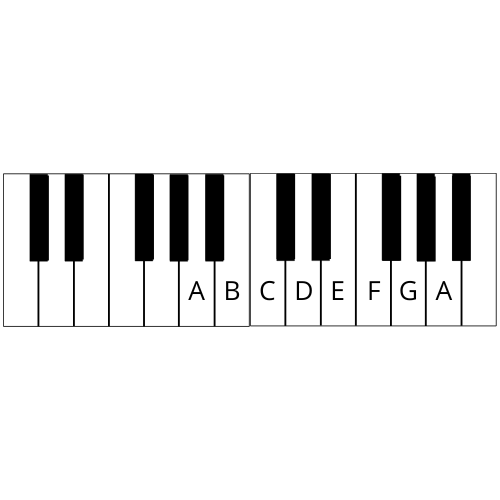
Looking at the image at the right, you
can see one full octave, including all 12 notes. The piano keyboard is made up
of 7 of these octaves, numbered from C1 to C7.
Chords are
groups of notes that come together to form harmony.
Play three
or more notes at the same time, and you have a chord, a sound with emotion and
depth.
The magic
of chords is that they feel like something: happy, sad, dreamy, dark,
unresolved, or even mysterious. They are the emotional geometry of music. The
way you move from one chord to another creates tension and release, the
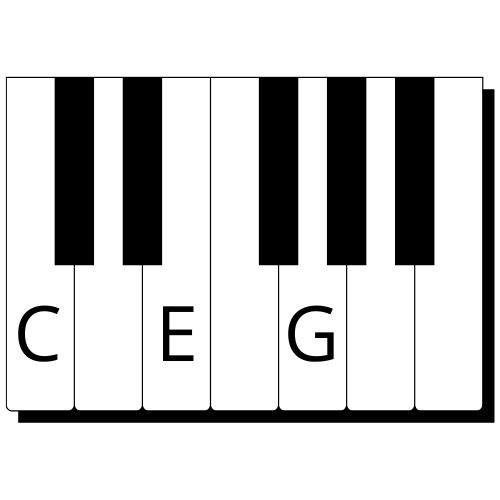
heartbeat of musical storytelling. Below a C major chord:
Every chord
is built on intervals, which are the distances between notes. The most
basic chord, the triad, is made up of the 1st, 3rd, and 5th notes of a scale.
That’s all it takes, and from this simple pattern springs an infinite world of
sound: major, minor, diminished, augmented, and more. Each chord adds a
different color to your musical palette.
To
understand chords is to understand harmony. When you look at a song, you no
longer see isolated notes, you see architecture.
You can
predict what comes next, reharmonize, and freely improvise within the
structure.
Once you
start recognizing chords automatically, your playing becomes fluent. You’ll be
able to build songs, harmonize melodies, and transform chord progressions into
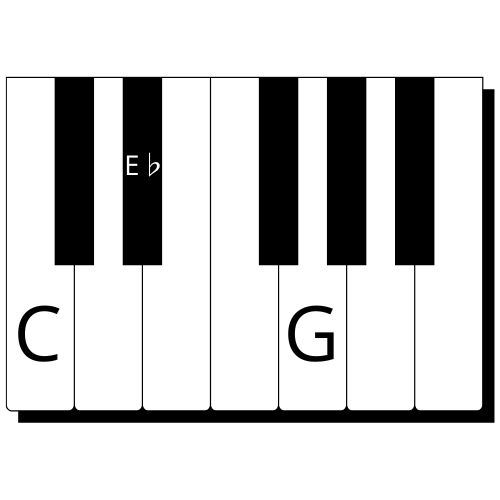
something uniquely yours. Below a C minor chord:
Chords are the foundation of music, they make it
sound full and alive. A chord
usually consists of multiple notes, most often three (a triad), but sometimes
two to five. The most common types are major and minor chords.
The
difference between major and minor lies in the middle note: it’s raised or
lowered by one semitone. See the images below for an example.
Scales define the context. A scale tells you which notes sound good together,
which chords belong to it, and how to move between them. You’ll also quickly
notice which notes or chords fall outside the scale and therefore sound off.
Chords live inside scales; each chord is like a snapshot of a few notes from a
larger structure. Every scale
contains seven basic chords, connected to the seven notes within it. Improvising
= Navigating
The scale
is your map, and your fingers are the travelers.
You can move with logic or
with feeling, but always with direction. That’s why scales are essential for
improvisation: they give you boundaries within which freedom can thrive.
Practicing
scales also builds technique: balance, coordination, and muscle memory. Beyond
technique, you start to feel the emotion of music. Each scale has its own
personality: the sadness of A minor, the clarity of C major, the tension of G
minor.
The
Major & Minor Scales
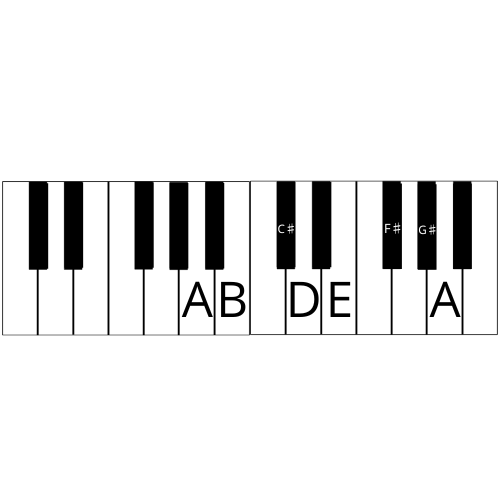
Below are
the scales of A major and A minor. The difference between major and minor lies
in the spacing between the notes. Both follow the same logical steps and rules
defined by whole tones and semitones (a whole tone = 1, a semitone = 0.5). The
formulas are like this:
Major: 1 -
1 - 0.5 - 1 - 1 - 1 - 0.5
Minor: 1 -
0.5 - 1 - 1 - 0.5 - 1 - 1
In the end,
it’s important to know these three elements, but even more important to
understand them. Memorizing them works, but you truly learn when you understand
how music is built.
Once you
realize that every song is based on just one scale within which only seven
notes and seven chords fit, everything starts to make sense. You see
that each song has a root note, and that most use just three or four chords.
What makes
this so powerful is that when you truly know a scale and its contents, it gives
you the ability to improvise. Whether that’s over an existing song or through
freely exploring within the scale yourself, both give you an incredible sense
of musical freedom and creativity.